Summer “buzz kill”

Post by Jen Berlinghof

The sun had set, the campfire was doused, and the food was stashed away for the night as my sons and I tucked ourselves into our sleeping bag cocoons, thoroughly exhausted in a way one can only be from a day spent entirely outdoors. Still, sleep would not come easily. The whirling drone of thousands of annual cicadas buzzed through the nylon walls of our tent loud enough to overpower our fatigue. I lay awake, thinking it odd the cicadas would be calling after dark, when I caught a hint of the rising full moon through the ceiling screen and realized they were staying up late to party with the extra light. One of my boys groaned, “Isn’t there anything that can stop these CICADAS?” As a matter of fact, the next day we found just the thing: a cicada killer wasp (Sphecius speciosus).

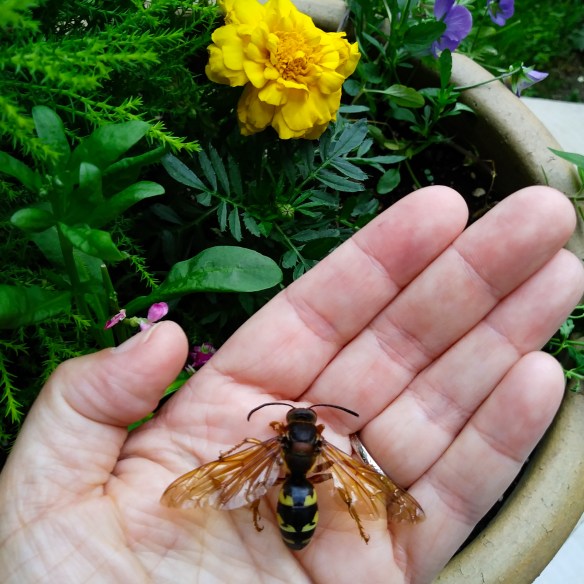
The author holds a dead cicada killer wasp in her palm. Photo © Lake County Forest Preserves.

Continue reading

“Toadally” awesome!

Post by Jen Berlinghof

Last week, our Wetland Explorers summer nature campers went wild…in a good way! We were hiking along the Des Plaines River Trail when we came upon a major toad hatch-out. Hundreds of dime-sized toadlets took over the trail, prompting shrieks of excitement from the campers. The kids scurried around, scooping up handfuls of toads, trying to save all the hopping and popping amphibians from potentially hazardous bike tires and hiking boots along the trail.

Continue reading

A tale of two squirrels

Post by Jen Berlinghof and Allison Frederick

Everywhere you look this time of year, animals are tending to nests during spring’s baby season. Squirrels are very active at this time with the bounties of spring. Food reserves from winter are low, and energy demands are high with young in the drey (their leafy, treetop summer homes) demanding to be fed. So, squirrels turn from their habits of digging for winter caches and begin eating buds, flowers, fungi and lichens. They will take advantage of almost ANY food source at this time of year!

Continue reading

Happy New Year!

Video

Happy Winter from the Lake County Forest Preserves!

Video by Brett Peto

Whether venturing outside for fresh air and exercise, or finding a gorgeous spot to sit quietly and reflect on the past year, we find great peace in the Lake County Forest Preserves.

Thank you all for following along on our adventures this year. We encourage you to find a quiet spot to just breathe—perhaps the still woodlands of Captain Daniel Wright Woods:

Cheers to a new winter and peaceful new year!

In search of river otters

Guest post by Andrew Rutter

I had just finished my time as a Masters student at Southern Illinois University with the Cooperative Wildlife Research Lab, studying river otter (Lontra canadensis) ecology, when I took my first full-time position as a wildlife biologist with the Lake County Forest Preserve District in Illinois.

Having spent the last two years of my life entirely focused on river otters, I figured my time studying the species was at an end. Although my research team and I found them to be relatively abundant where we focused our research efforts in southern Illinois, I did not expect the same to be true farther north in Lake County.

Continue reading

A parade of colors

Guest post by Nan Buckardt

Watching kids play in a pool, waiting for burgers to come off the grill, sitting on a curb enjoying a parade—these are all images that I conjure when daydreaming about summer.

Luckily, I don’t have to wait to watch a parade; I can see a parade every day this summer by taking a walk in our Lake County Forest Preserves.

Not the type of parade with floats and brass bands, but nature’s parade of colors, textures and blooms. My favorite preserves to see this parade are those that have splendid expanses of prairie.

Continue reading

“Submarine cottages”

Post by Jen Berlinghof

Late spring and early summer are busy seasons for children visiting the Lake County Forest Preserves for pond study programs. The shorelines of ponds pulse with the excitement of students, nets in hand, ready to discover the macroinvertebrates teeming under the water’s surface. The most delightful find this season by students has to be what Henry David Thoreau once called the “submarine cottages” of caddisfly larvae.

Continue reading

Tick season has arrived.

Post by Jen Berlinghof

Spring seems to be a bit accelerated this year in the Lake County Forest Preserves. Trillium are already blooming at Ryerson Woods. Yesterday, I even saw a tiger swallowtail butterfly, wafting its way through the dappled light of the forest. Both of these species are typically associated with mid-May. With earlier than usual spring weather comes earlier than usual “tick season.” Like the trillium and swallowtail, ticks are a part of our natural areas.

By learning more about ticks, along with some mindful actions before you head outside, interactions with ticks can be minimized so our enjoyment of the outdoors can be maximized.

9

Contrary to what many people think, ticks are not insects. They are arachnids. Like spiders, they have two body parts and eight legs. In addition, ticks have intricate mouthparts designed to bite and hang onto their host, which can be any warm-blooded animal in the area, including us.  Continue reading

Skunk stories

Post by Jen Berlinghof

Just like fish stories, it seems everyone has a skunk story to tell. I have many, but my favorite one happened a few years ago in the spring, when I was getting ready to teach education programs at Greenbelt Forest Preserve. Before the students from a local school arrived, we were busy unloading supplies and setting them out around the preserve. When we returned to the van, we found a skunk sauntering right up the open lift-gate, looking curiously like he might climb in! We froze, chanting in a hushed tone to ourselves, “Please don’t go in there, please don’t go in there.” Either our chants worked, or he realized the preserved insects in the cases he was checking out were not a good meal. He casually wandered back to the brushy field and was long gone by the time the bus arrived.


Continue reading