I found a feather today and it stopped me in my tracks. There it was, tucked into the dewy grass—a single, beautiful feather just lying next to my sidewalk.
It’s not uncommon to come across feathers in my work at the Lake County Forest Preserves in northern Illinois. My naturalist brain immediately started to assess the discovery, analyzing it on a few key points.
The weather has varied a lot so far this spring. Minor snow squalls and hailstorms trade off with wonderfully warm, sunny days, which seem to call out, encouraging us to find the signs of spring. When the season brings all the beauty and promise of plants and flowers emerging from the winter, I feel as if I am seeing friends old and new once again. It’s rather comforting to know that regardless of what occurs in human society, spring carries on in the Lake County Forest Preserves in northern Illinois.
Many of the floral signs of spring are ephemeral, created by healthy populations of plant species that only emerge above ground for six to eight weeks—between the start of the spring warm-up and the closure of the canopy, when the trees grow a full set of leaves. Their live-fast lifestyle is an evolved response to their shade intolerance. Ephemerals need to finish flowering and fruiting while they have enough sunlight, and also put something away for a rainy day. They stash the sugar they make during photosynthesis in underground storage organs such as corms, bulbs, and rhizomes. The starchy carbon will see them through the winter into the next spring.
Some residents of our woodlands and prairies announce the arrival of spring in understated ways that require careful attention. The early-flowering harbinger of spring (Erigenia bulbosa), and later bloodroot (Sanguinaria canadensis), are two examples. Other signs of spring are exuberant and showy, such as the carpets of marsh marigold (Caltha palustris) at Ryerson Conservation Area in Riverwoods. And of course, no spring display is quite so welcome as large-flowered trillium (Trillium grandiflorum) in full bloom. (This sight is only possible when the white-tailed deer (Odocoileus virginianus) population is stable; otherwise these beautiful plants are eaten out of existence.)
Not all spring wildflowers are showy, though, and not all of them are ephemeral. Arriving later in the season, Jack-in-the-pulpit (Arisaema triphyllum) is one of the most common spring wildflowers in our woodlands. It’s usually entirely green in Lake County. Rarely, some maroon stripes may also be seen on the inflorescence, the reproductive portion of the plant.
There’s solace to be found in the fact that the rhythms of nature march on. This spring, the sun still rises. The wild leek (Allium tricoccum) still pulses its verdant green arms through the pulpy leaf litter of the forest floor. The birds still surge through the skies as they migrate to and through the Lake County Forest Preserves in northern Illinois. Like us, some of these birds are inclined to congregate in large communities. Over the years, the colonies of a particular species, the purple martin (Progne subis), have become largely reliant on people to provide shelter for their nesting flocks.
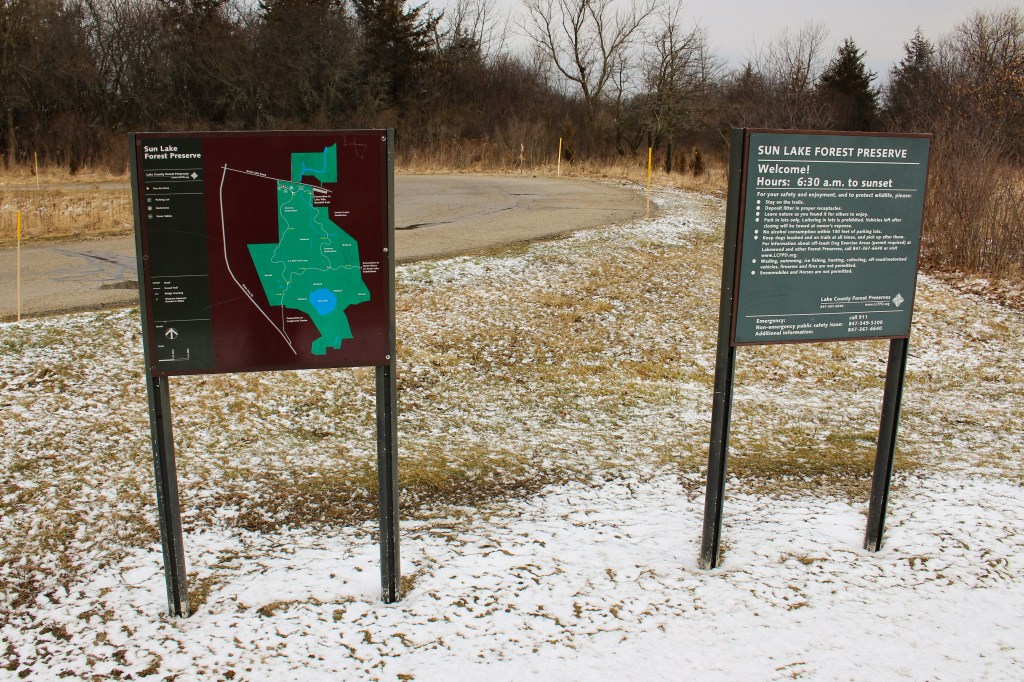
The sky to the west was robin’s egg blue, a clearing in the day’s dose of clouds. They had just sneezed a handful of snow, already melting. I drove with the radio off. I didn’t know whether to wear my regular hiking boots or a pair of Wellington boots I’d packed at the last moment. The trail could be soggy, or maybe not. I was on my way to Sun Lake in Lake Villa, part of the Lake County Forest Preserves in northern Illinois.
For this month, I decided to revisit the idea behind my February 2019 post, when I explored a new-to-me preserve and wrote up my observations as a virtual tour. Readers seemed to enjoy it, and I enjoyed circling another name on the map I keep at my desk. So, here I was, about a year later, ready to chronicle another tour. Find a comfy chair and a warm mug. Here’s a snapshot of Sun Lake as I saw it.
Late last summer, I literally watched a groundhog (Marmota monax) fatten up before my eyes. He’d made a burrow in the field outside my office window and frequently visited the rain gardens around the Edward L. Ryerson Welcome Center in Riverwoods, part of the Lake County Forest Preserves in northern Illinois. We watched him scamper back and forth, snipping flower tops here and there, always with a mouth crammed full of flora.
Fast forward to early February, and as I look out across the same field, now dotted with small snow drifts punctuated by tufts of grasses gone tawny, I think about that groundhog curled tight in his burrow and deep in hibernation, oblivious to the hubbub of a day in his honor.
Groundhogs (Marmota monax) are active during daytime, particularly early morning and late afternoon. Stock photo.Continue reading →
Post by Brett Peto. All mink images and footage by John D. Kavc.
Yes, it’s almost that time of year. American mink (Neovison vison) mating season. I know, I’ve been waiting for it, too. February is celebrated for human romance: fancy dinner dates, shiny gifts, and long walks on the Des Plaines River Trail. But it’s useful to step out of our human-focused perspective once in a while. And thanks to our comprehensive Wildlife Monitoring Program, we know minks live in the Lake County Forest Preserves in northern Illinois. So, let’s examine why humans aren’t the only species that looks forward to February 14.
I keep thinking about angles. Not the kind you measure with a protractor, but those you measure with your mind. The angle of a story, a conversation, or a project. Photography, of course, uses physical angles—where’s the camera pointed? is the sun directly overhead or is it the sweet time of golden hour?—but the best photos make you want to see even more. They make you want to break open the frame and soak in every bit of the Lake County Forest Preserves in northern Illinois.
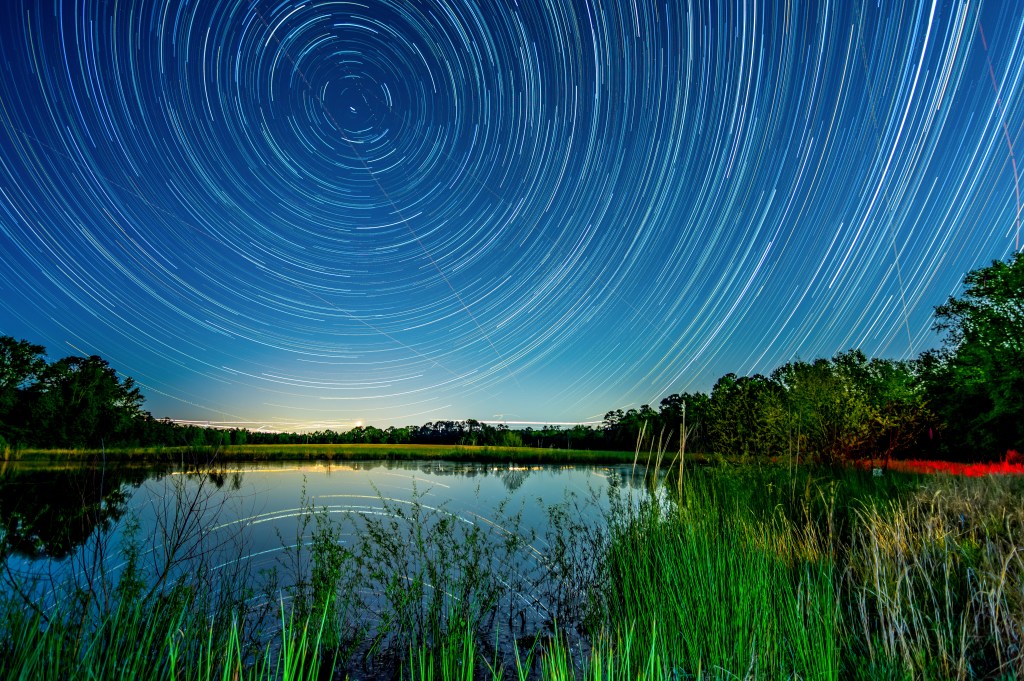
Since it’s nearly the end of 2019, I thought I’d turn 180 degrees and peruse the photos uploaded to our group Flickr pool since January 1. Suffice to say: we’re spoiled. Spoiled with the beauty of Lake County’s flora, fauna, and natural areas, and the talent of the photographers who capture it for everyone to see. Trees and shrubs in their bright fall wardrobes on either side of a trail draining into a vanishing point. A sandhill crane (Grus canadensis) with both wings up like a paper airplane as it dashes to take off. A whirlpool of stars spun around a rich blue sky over a tranquil wetland.
I’ve gathered these moments plus seven more below, but that’s only a small taste. I encourage you to browse the rest of the visual buffet as we make the turn out of the 2010s into the 2020s. And, hey! You might become inclined to upload that shot living on your phone, camera, or computer.
Come late November, most of us have turkeys on the brain. But a different type of turkey is taking to the skies at this time of year on its annual migration south: the turkey vulture (Cathartes aura). You can spot them in the sky or on the ground in the Lake County Forest Preserves in northern Illinois.
Everyone has one! At least, anyone who regularly hikes in the Lake County Forest Preserves in northern Illinois has one: a favorite trail. It might be the trail near your home or the one that reminds you of a secret only-I-know-about-this spot growing up. Maybe it holds a special memory. Whatever the reason, something about it always sparks joy in your heart.
Fall is the time of harvest here in the Midwest. Golden stacks of hay bales, farmer’s markets teeming with end-of-season produce, and above all, apples. But step away from the orchard and into an oak woodland and you’ll find a different kind of autumn apple: an oak apple gall. What looks like a small, lime-green, spotted apple dangling from an oak leaf is not a fruit at all, but rather a secret abode for a tiny wasp.
There are more than 50 species of oak apple gall wasps in North America. Each one creates a unique fruit-like structure that protects and feeds its eggs and larvae as they develop. Lately, I’ve been finding many dried, spent brown husks created by the larger empty oak apple wasp (Amphibolips quercusinanis) around the Lake County Forest Preserves in northern Illinois.







 Lake County Nature