Fast-forward fall

Even though Illinois recently received a break from this summer’s heat and drought, the precipitation deficit that remains statewide has kicked off autumn with atypical natural events. Thus far, the year 2012 has been the fourth driest on Illinois record. However, it has been raining acorns and fall colors have been peeking through the greenery since late August—three weeks earlier than usual. This fast-forward to fall is a tree’s way of protecting itself when water is in short supply. The vibrant color displays of autumn, which seem so lively, are actually a sign that a tree is entering dormancy.

These flashes of fall colors are a result of changes in pigments. The dominant green pigment in leaves is chlorophyll. The leaves in a tree are like little factories, mixing together a recipe of specific ingredients (sunlight, carbon dioxide and water) to make food for the tree’s growth. Chlorophyll acts as the “chef” in this process, called photosynthesis; its presence is necessary in bringing everything together.

Typically, autumn’s cool nights and shortening days trigger photosynthesis to slow down. The scarcity of one key ingredient, water, is triggering this earlier-than-average dormancy. As the work of the leaves comes to an end for the year, chlorophyll breaks down and reveals yellow and orange pigments that have hidden behind its green cloak all summer. Leaves that contain the pigments xanthophyll and carotene—as do hickories, cottonwoods, elms and some maples—will change to vivid shades of yellow and orange as the green fades. Continue reading

Camouflage revealed

Early fall finds most naturalists outside in fields of waist-high wildflowers. This was the case recently when a few Lake County Forest Preserves Environmental Educators stumbled across a miniscule critter with mighty camouflage capabilities. So small and inconspicuous, it was almost dismissed entirely as merely a part of the black-eyed susan flower (Rudbeckia hirta)—until it started to move.

Continue reading

Shrew crossing

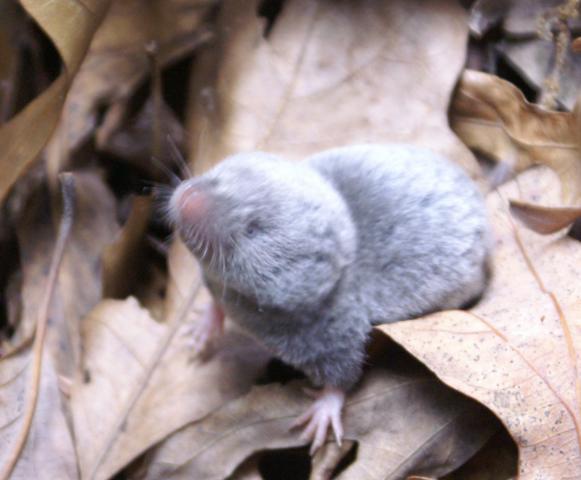
While we revel in the slow pace of these last dog days of summer, sipping one last lemonade on the porch or wandering down one last stretch of beach, there is another mammal pulsing with life that has no such concept of slowing down. One of the most abundant mammals in Illinois, the shrew lives its life entirely in the fast lane—tunneling about a foot below the ground’s surface.

There are three species of shrews that live in Lake County, Illinois. The most common species, and largest at about 4 inches long with a 1-inch tail, is the lead-colored short-tailed shrew (Blarina brevicauda). The short-tailed shrew lives in a variety of habitats from forests to grasslands and typically only lives 1-2 years.

The least shrew (Cryptotis parva), at about 3 inches long, can be distinguished by its cinnamon-colored fur and extremely short tail. Least shrews are most commonly found in open grassy areas. About the same size as the least shrew, the masked shrew (Sorex cinereus), appears grayish-brown with a longer tail and prefers low wet areas such as floodplains.

Continue reading

Nature’s fireworks

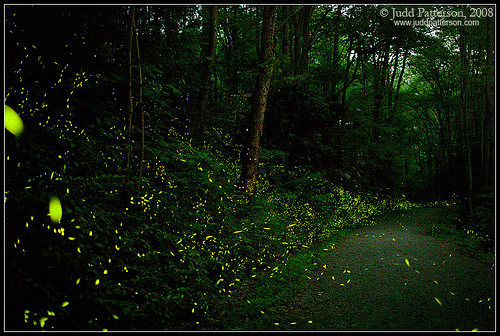
This time of the year brings dazzling firework shows high in the sky. But, look closer to the ground in grassy yards and woodlands, and you will catch that same sense of awe as a myriad of lights burst, creating nature’s very own fireworks display. Watching and catching fireflies is one of the most quintessential summer experiences in the Midwest. There is a giddiness in holding a creature in your hand and watching it glow before it flies away to join the show. Continue reading

Year of the Bat

Post by Allison

Amazing. Fascinating. Adorable. Essential. These are the first words that come to mind when I think about bats. Would you use the same descriptors? 

Bats are highly beneficial and play a vital role in maintaining the balance of nature. They help control insect pests and are vital pollinators and seed-dispersers for countless plants worldwide. Yet the world’s only flying mammal is still among the most feared and misunderstood of animal groups. Continue reading

Muskrat musings

It was the calm before the storm. The pond was the calm, sheer and smooth. The bus that was due with over 100 middle school students for a field trip was the impending storm. Although students are always a good storm, filling the forest preserve with energy, it is inside these few moments of quiet before the bus arrives that nature seems to poke its head out to see if the coast is clear. This particular morning, the glassy water became rippled in V-shapes like geese migrating in the sky. A lone muskrat (Ondatra zibethicus) slid through the water towards a clump of cattail, its snake-like tail slithering behind him.

Continue reading

Turtle tales

I’ve spent the past few weeks scooping nets into the pond at Captain Daniel Wright Woods with 4th – 7th grade students, studying what is lurking along the mucky bottom during a Pond Study program. Before the group spreads out along the shoreline, I show the students examples of animals that make their home in the pond. By far, the item that elicits the biggest reaction is a snapping turtle shell that is the size of a dinner plate. Hands shoot up in the air, and everyone has a story about an encounter with this hulking reptile—from witnessing a female digging a nest in a backyard garden to being stopped in a traffic jam caused by a turtle crossing the road. Continue reading

A screech-owl’s story

Last week, many of us who work at the Lake County Forest Preserves had to say a sad goodbye. Our resident eastern screech-owl (Otus asio) passed away in the middle of the night. This male owl had spent the past seven years as an ambassador for the Lake County Forest Preserves, teaching thousands of people about the adaptations of raptors and owls. I have seen time and time again—from school children on education field trips to adults attending special events—a person’s eyes lock in and a look of amazement wash over them upon meeting this charismatic bird.

Sadly, his story is not uncommon. This particular bird was recovered in January 2004 as a juvenile. He was found by a concerned citizen in a driveway in Round Lake, Illinois with obvious head trauma and his left eye swollen and filled with blood. He was taken to Barnswallow, a raptor rehabilitation center in Wauconda, Illinois. It is suspected that this screech-owl was hit by a car, but he also had tiny sores on his talons and translucent, sheared tail feathers. These latter symptoms are signs of secondary viral infections caused by the West Nile Virus. After spending 16 months at the rehab facility, he was deemed unsuitable for release back into the wild due to the uncertainty of his eyesight in the injured eye. In the spring of 2005, he came to live in his very own mews (i.e. flight cage) near the farm area at Ryerson Woods. There he joined another resident bird, a red tailed-hawk (Buteo jamaicensis). Continue reading

Warbler fever

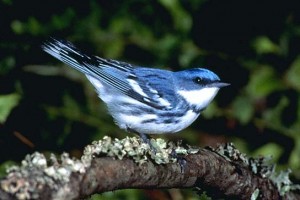
Birding fever hit a high this past weekend in natural areas throughout northern Illinois. Birders flocked in throngs with binoculars strung on their necks like potential Olympic medals and a hope of spotting some of the most coveted migratory birds— wood-warblers. Members of the family Parulidae, wood-warblers are the colorful jewels of migration from the sapphire blue of a cerulean warbler (Setophaga cerulea) to the amber orange of a Blackburnian warbler (Setophaga fusca). Yet, as these birds flit about in the treetops, no color is as visually striking as the lemony-yellow citrine that adorns so many warblers as they pass through our area on a flyway. Once these impish birds reach their destinations (as far as northern Canada for some species) and breed, they will molt their flamboyant plumage and become far less conspicuous, which is why seeing them in the spring is considered such a prize for birders.  Continue reading

Red admirals at attention

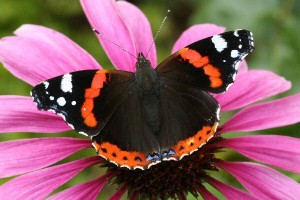
Last week while visiting Lyons Woods, I noticed that a large patch of garlic mustard was quivering. When I got closer, I found that it was not the breeze making the plants sway, but rather a huge group of red admiral butterflies (Vanessa atalanta) flitting from flower to flower. In many areas, all you have to do is walk out your front door to witness the population explosion of these ubiquitous butterflies that is sweeping the northeastern United States this spring.

Continue reading