Brett Peto has served as Environmental Communications Specialist for the Lake County Forest Preserves in northern Illinois since 2017. A graduate of Elmhurst College in 2015, Peto edits copy, selects and retouches photos, and ponders the Latin roots of species names in his spare time. Ever since his first science column in the college newspaper, Peto has found fun in the broad accessibility and deep understanding of complex subjects that effective science writing requires.
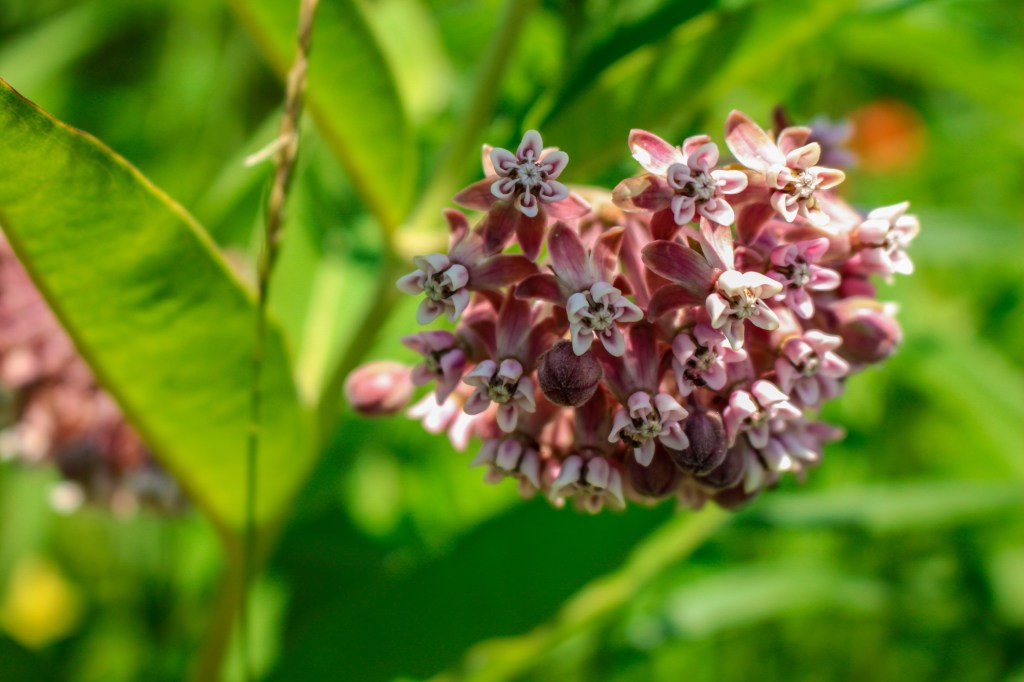
Being home more these past months has allowed my family copious time to observe the common milkweed (Asclepias syriaca) in our garden go through its life cycle day by day. We’ve witnessed the transformation from wily little sprouts in early summer to blooming beasts, with pompoms of eraser-pink flowers wafting perfume across the yard—even threatening to take over the footpath—by Fourth of July. Now in the sweet days of September, our milkweed is laden with swelling seed pods, ready to burst with floating seeds like so many little white parachutes scattered in the autumnal sky. The situation is similar in many of the Lake County Forest Preserves in northern Illinois.
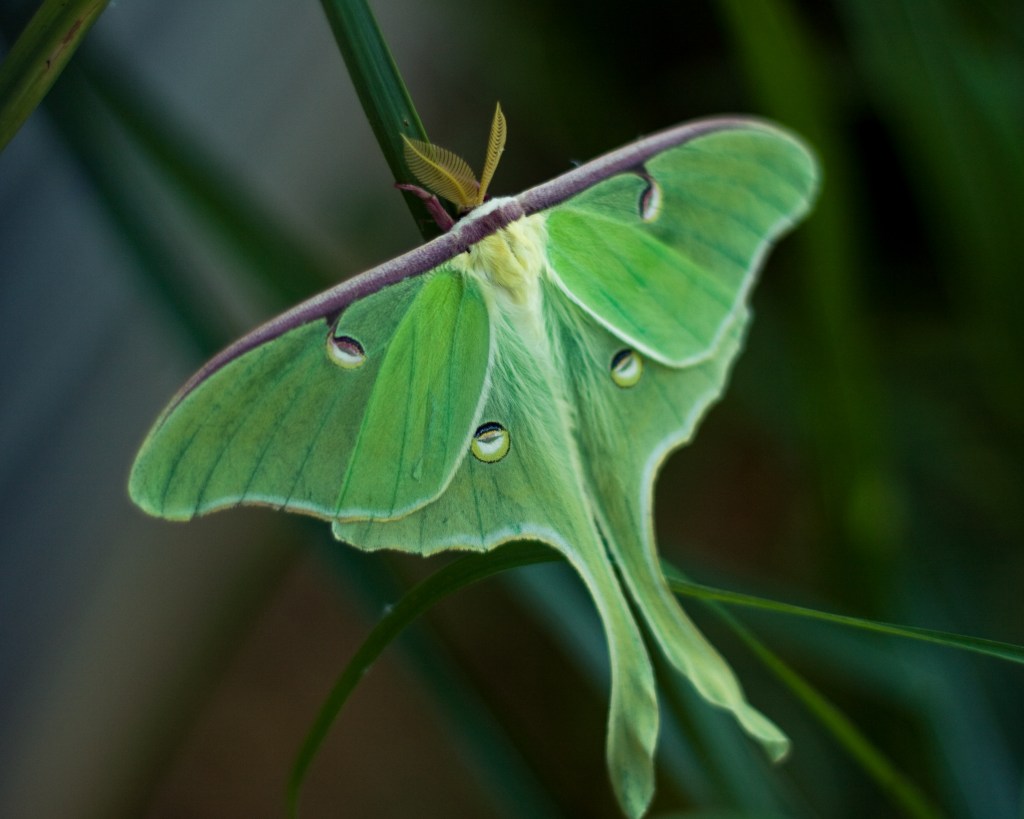
A full moon rises, a screen door slams shut, a katydid’s creaking calls echo, and a Luna moth (Actias luna) flutters in circles around the back porch light. We’re captivated by this green ghost of summer, concealed by broad leaves and seen rarely during the day, emerging at night only to mate for its few fleeting days of adulthood. How lucky it is that Luna moths live in the Lake County Forest Preserves in northern Illinois.
The bright green wings of the Luna moth (Actias luna) are instantly recognizable. Stock photo.Continue reading →
I found a feather today and it stopped me in my tracks. There it was, tucked into the dewy grass—a single, beautiful feather just lying next to my sidewalk.
It’s not uncommon to come across feathers in my work at the Lake County Forest Preserves in northern Illinois. My naturalist brain immediately started to assess the discovery, analyzing it on a few key points.
The weather has varied a lot so far this spring. Minor snow squalls and hailstorms trade off with wonderfully warm, sunny days, which seem to call out, encouraging us to find the signs of spring. When the season brings all the beauty and promise of plants and flowers emerging from the winter, I feel as if I am seeing friends old and new once again. It’s rather comforting to know that regardless of what occurs in human society, spring carries on in the Lake County Forest Preserves in northern Illinois.
Many of the floral signs of spring are ephemeral, created by healthy populations of plant species that only emerge above ground for six to eight weeks—between the start of the spring warm-up and the closure of the canopy, when the trees grow a full set of leaves. Their live-fast lifestyle is an evolved response to their shade intolerance. Ephemerals need to finish flowering and fruiting while they have enough sunlight, and also put something away for a rainy day. They stash the sugar they make during photosynthesis in underground storage organs such as corms, bulbs, and rhizomes. The starchy carbon will see them through the winter into the next spring.
Some residents of our woodlands and prairies announce the arrival of spring in understated ways that require careful attention. The early-flowering harbinger of spring (Erigenia bulbosa), and later bloodroot (Sanguinaria canadensis), are two examples. Other signs of spring are exuberant and showy, such as the carpets of marsh marigold (Caltha palustris) at Ryerson Conservation Area in Riverwoods. And of course, no spring display is quite so welcome as large-flowered trillium (Trillium grandiflorum) in full bloom. (This sight is only possible when the white-tailed deer (Odocoileus virginianus) population is stable; otherwise these beautiful plants are eaten out of existence.)
Not all spring wildflowers are showy, though, and not all of them are ephemeral. Arriving later in the season, Jack-in-the-pulpit (Arisaema triphyllum) is one of the most common spring wildflowers in our woodlands. It’s usually entirely green in Lake County. Rarely, some maroon stripes may also be seen on the inflorescence, the reproductive portion of the plant.
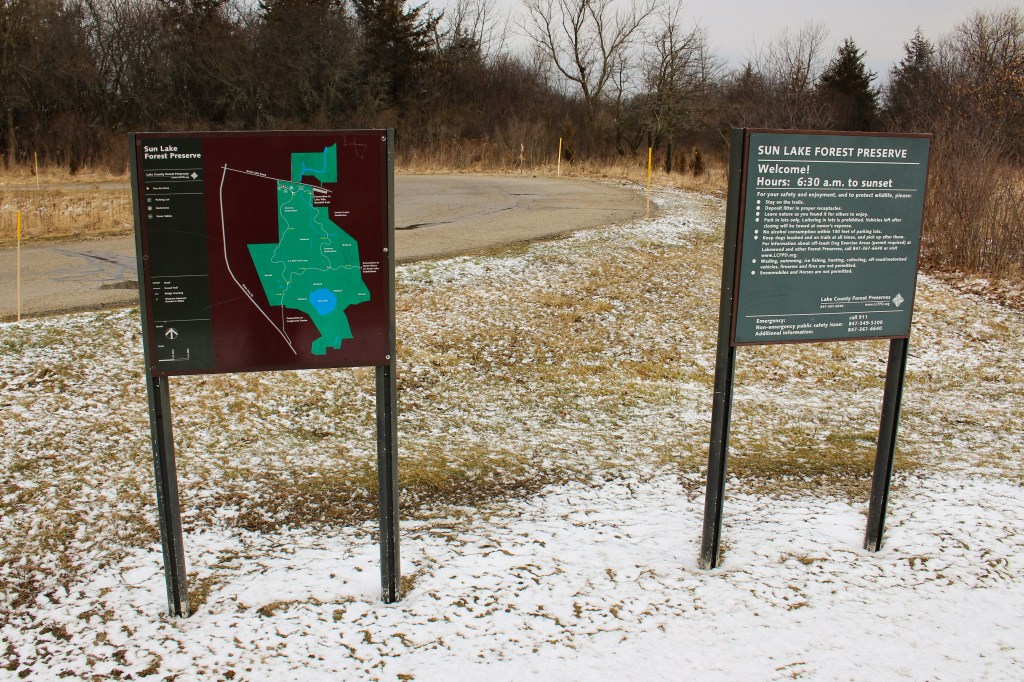
The sky to the west was robin’s egg blue, a clearing in the day’s dose of clouds. They had just sneezed a handful of snow, already melting. I drove with the radio off. I didn’t know whether to wear my regular hiking boots or a pair of Wellington boots I’d packed at the last moment. The trail could be soggy, or maybe not. I was on my way to Sun Lake in Lake Villa, part of the Lake County Forest Preserves in northern Illinois.
For this month, I decided to revisit the idea behind my February 2019 post, when I explored a new-to-me preserve and wrote up my observations as a virtual tour. Readers seemed to enjoy it, and I enjoyed circling another name on the map I keep at my desk. So, here I was, about a year later, ready to chronicle another tour. Find a comfy chair and a warm mug. Here’s a snapshot of Sun Lake as I saw it.
Post by Brett Peto. All mink images and footage by John D. Kavc.
Yes, it’s almost that time of year. American mink (Neovison vison) mating season. I know, I’ve been waiting for it, too. February is celebrated for human romance: fancy dinner dates, shiny gifts, and long walks on the Des Plaines River Trail. But it’s useful to step out of our human-focused perspective once in a while. And thanks to our comprehensive Wildlife Monitoring Program, we know minks live in the Lake County Forest Preserves in northern Illinois. So, let’s examine why humans aren’t the only species that looks forward to February 14.
Everyone has one! At least, anyone who regularly hikes in the Lake County Forest Preserves in northern Illinois has one: a favorite trail. It might be the trail near your home or the one that reminds you of a secret only-I-know-about-this spot growing up. Maybe it holds a special memory. Whatever the reason, something about it always sparks joy in your heart.
Good things start at seven in the morning. That’s when our group of four hiked 15 minutes off-trail into the heart of Middlefork Savanna in Lake Forest, part of the Lake County Forest Preserves in northern Illinois.
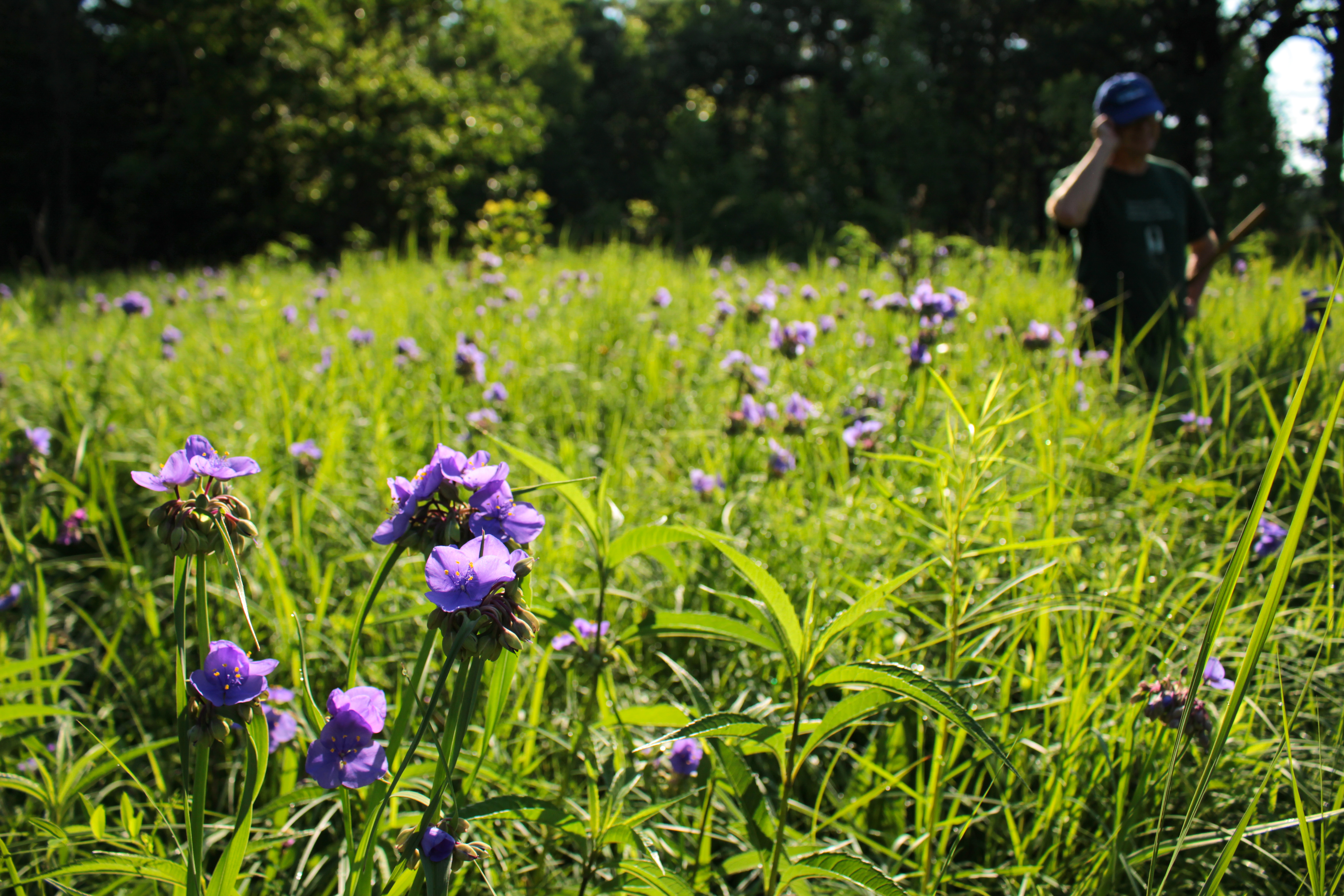
The air was warm, the sunshine spread everywhere. Spiderwort blooms were freshly open, a waist-high meadow of bluish-purple fireworks. We found the steel T-post marking the start of the day’s first transect and the red flag for the first plot.
Then we gathered our tools. A one-meter-square collapsible wooden quadrat, retractable tape measure, clipboard, data sheets, and each other’s knowledge of plants.
Well, my own knowledge, not so much. I was there to take photos and observe the three experts onsite: Pati Vitt, Manager of Ecological Restoration; Ken Klick, Restoration Ecologist II; and Pete Jackson, who authored a 2009 study on this preserve’s plant communities that served as his thesis for a master’s degree program. In my head, I called them the Plant Team.
In my early twenties, I believed adventure was found in the tallest mountain, the deepest ocean, the largest cavern. I chased whales, orca, brown bears, bald eagles, and other charismatic megafauna. It took decades to realize I didn’t need to seek these animals or climb these mountains to find adventure. Some of the best adventure awaited me in my own backyard. This led me to join the Education Department at the Lake County Forest Preserves in northern Illinois in October 2018. What an adventure it’s been!
Anyone who’s attended a program taught by our staff or volunteers knows these educators are knowledgeable and passionate. This group ignited my latest adventure—birding—though I can’t point to a single component that sparked my newest hobby. It could have been my awe for the birders in this group, their love for birds and their impressive ability to bird by ear. It might have been my draw to a new challenge. The patience, attention to detail, and dedication it takes to be an effective birder. It may have been the rush of excitement, getting a glimpse of a rare species for a brief moment as it makes its annual migration. Perhaps all of these were feathery factors. Regardless, I’m hooked.