The Lake Plain covers 15 miles of shoreline and over 4,500 acres between Waukegan, Illinois and Kenosha, Wisconsin. Here, ancient beach ridges tell stories spanning 3,000 years of restless freshwater tides. Eastern prickly pear, a drought-tolerant cactus, thrives beside arctic bearberry, a cold-climate shrub. Endangered piping plovers continue their species’ comeback story each season they return to nest.
Visitors find what they didn’t know they were seeking. Environmental stewards discover their calling, families create memories across generations and others take solace in nature. The Lake Plain Coalition, an alliance led by the Lake County Forest Preserves, other public agencies, private organizations and individuals, is proving collective care can preserve the irreplaceable.
Unexpected Discovery
Before joining the Forest Preserves, Belynda Alberte was an aspiring botanist in graduate school.
Dave Rogers, her mentor and a professor at University of Wisconsin-Parkside, brought Alberte to Illinois Beach State Park in Zion.
A waterway called the Dead River meanders through the park, draining into Lake Michigan. “I remember stepping south of the Dead River for the first time. Dave walked right into the water, even though he was wearing tennis shoes, and I thought, ‘Whoa, we’re doing this?’” Alberte said.
The plant diversity there astonished her. “Things are dynamic because of the sand. Plants grow in different places compared to other habitats.”
Unlike many coastal zones, the Lake Plain is nearly contiguous with limited roads, buildings and industry.
“It needs help keeping invasive species out, but it’s thriving and beautiful,” said Alberte.
We hired her in 2024 as our first Lake Plain coordinator, supported by government and foundation grants. She’s leading efforts to restore the area’s habitats, secure funding and raise its profile.
Sacred Shores
We own 229 acres in the Lake Plain called Spring Bluff Forest Preserve (Winthrop Harbor), bordering Wisconsin. A mosaic of habitats—including prairie, savanna, wetland, foredune, beach and water—makes up the region’s landscape. Among them, dunes play a vital role.
The sandy hills protect inland areas against storm surges and provide homes for plants and animals adapted to intense sun, winds and waves.
Hardy native plants—American beachgrass, dune willow, creeping juniper—grow deep, widespread roots to stabilize the shifting sands. “As you move west in the Lake Plain, the soil is less sandy and has more nutrients so trees can grow,” said Alberte.
Long, narrow hilltops bend westward from the lake and dunes in a fan shape. Visible on satellite imagery, these ridges are the former shorelines of Glacial Lake Chicago. It filled what would become the Lake Michigan basin 14,000 years ago, extending to present-day La Grange, Illinois and covering northwestern Indiana.
Between the ridges are swales: low, marshy areas that support wetlands. “As you go into a swale, that’s the lower part of a former beach where water sits,” Alberte said. “It’s washboard topography. Ridge, swale, ridge, swale. This is the last remaining dune and swale ecosystem in Illinois.”
Eight interconnected preserves create a living corridor along Lake Michigan’s shore. Everyone has a place here if they’re willing to tread lightly, explore often and help keep this landscape wild.
Stay on designated trails. Dune and swale ecosystems are fragile and easily damaged by foot traffic. Use designated trails to protect rare plant communities and nesting areas.
Leave only footprints. Note the belongings you bring in, and use marked areas for trash disposal. Leave everything natural where you find it—take only pictures and memories.
Observe without disturbing. Many species here are protected by state and federal law. Watch your step on official paths. Use binoculars and cameras to document your discoveries. Keep voices low near sensitive wildlife.
Respect wildlife and nesting. Give birds and animals space. Be careful not to approach, feed or touch wildlife. Dogs must remain leashed and on designated trails. Refer to each landowner’s rules before bringing your pet.
“The Blanding’s turtle is an umbrella species,” said Gary Glowacki, manager of conservation ecology. “It relies on high-quality wetlands and open uplands” with well-drained soils, characteristic of the Lake Plain.
Rusty patched bumble bees pollinate Kalm’s St. John’s-wort, Culver’s root and more. Sporting a rust-colored patch, the bee was the first pollinator listed as federally endangered in 2017.
Piping plovers might be the best symbol of habitat quality. “This is one of the few Great Lakes locations with confirmed nesting,” Glowacki said.
People benefit from this area, too. More than 8.5 million Illinois and Wisconsin residents rely on Lake Michigan for drinking water. The Lake Plain naturally filters water from five major tributaries, captures stormwater and stores carbon.
It also draws 2 million visitors annually for hiking, fishing, birdwatching and other recreation. “A lot of the natural heritage of the surrounding communities—Zion, Waukegan, Winthrop Harbor, Kenosha—is preserved here,” said Alberte. “That can’t be replaced.”
Plover Pals
Lake County is home to one of just two piping plover pairs successfully breeding in Illinois. Blaze and Pepper, both hatched in 2023, have successfully raised chicks including Sage, Willow, Juniper and Aster along Waukegan’s shoreline.
That’s big news for these sand-colored shorebirds, federally endangered in the Great Lakes. In the mid-1980s, their population had dropped to only 12 nesting pairs, down from an estimated 800 in the late 1800s.
Great Lakes piping plovers spend winters on the southeastern U.S. coast. While they can tolerate people outside of breeding season, they’re much more sensitive during nesting.
Even brief disturbances can prompt adults to leave their nests, eggs and chicks. Falcons, gulls, raccoons, foxes and feral cats also pose threats. Every individual matters when a species is endangered.
That’s where programs like Sharing Our Shore–Waukegan come in. “We focus on public outreach and education programs year-round, and monitor plovers on the beach from late April through mid-August,” said Carolyn Lueck, president of the Lake County Audubon Society, which partners with the City of Waukegan. “Our volunteers help protect the birds while connecting people to this habitat.”
Volunteers use binoculars and cameras to document plover courtship, nesting and chick-rearing while watching for threats. Paired with thousands of photos and videos, their detailed observations are shared with research partners and used in education.
Specialized teams working under federal and state permits also band chicks to help track their movements nationwide.
After each losing a parent as chicks, Blaze and Pepper were captive-reared and released in Illinois in 2023. They nested in Waukegan in 2024 and 2025, contributing to a growing Great Lakes population that reached 88 nesting pairs last year.
“I’m not just asking people to protect plovers. When we do, we’re protecting something much bigger—the health of an entire ecosystem that so many species, including people, depend on,” Lueck said.
Closer to home, another landscape offered a model—and sparked a little jealousy, Glowacki admits. “Although several groups protect the Indiana Dunes, it’s widely recognized as a single place. We thought, ‘Why don’t we have a catchy name that describes the region?’”
After surveying community members to better promote the area’s identity, The Lake Plain Coastal Preserves name was born. Crisp photography and drone video, logos, color palettes and a website bring it to life. They’re making waves.
The Lake Plain’s new logo reflects the Coalition’s core principle and stewardship philosophy: earned discovery through education and respect.
“I’ve come across people who visit a workday or tour and say, ‘I’ve lived here forever and didn’t know this was here,’” Alberte said. “Once people see it, they’re invested.” So are the Lake Plain Coalition’s dozens of partners. Besides us, state agencies, park districts, municipalities and nonprofits own land here.
It’s Alberte’s job to sustain momentum. Some days, she hikes through dunes and swales, mapping invasive plants for removal. On others, she staffs booths at events and fields calls from reporters.
But it’s not a one-person show. Volunteers clean litter from beaches, manage invasive species and monitor plants and wildlife. Their hours count toward local matching funds for grant applications. “Realistically, we wouldn’t be able to continue our efforts without their work,” said Alberte.
By the Numbers
Click through this slideshow for stunning stats about the Lake Plain.
Despite today’s protections, the Lake Plain faces threats. Not all natural areas are shielded from development. Four Superfund sites contaminated with industrial chemicals lie along the shoreline. The U.S. Environmental Protection Agency oversees cleanup—which began at some sites in 1987.
Alberte frequently calls upon the Lake Plain Invasive Plant Strike Team, which treats invasives across property lines. That collaboration continues with prescribed burns. Conducted by certified crews burning precise parcels of land, they re-create the periodic wildfires native plants and animals evolved with.
Nature doesn’t recognize human boundaries. A Blanding’s turtle doesn’t know whether it lives in Illinois or Wisconsin. “We want to get habitats on track and step back,” said Glowacki. “That’s, ideally, what conservation is. Fixing the issue, then letting nature take its course.”
A landscape thousands of years in the making deserves stewardship for those who come after. “There are very few Great Lakes ecosystems left where you have the whole picture,” said Alberte.
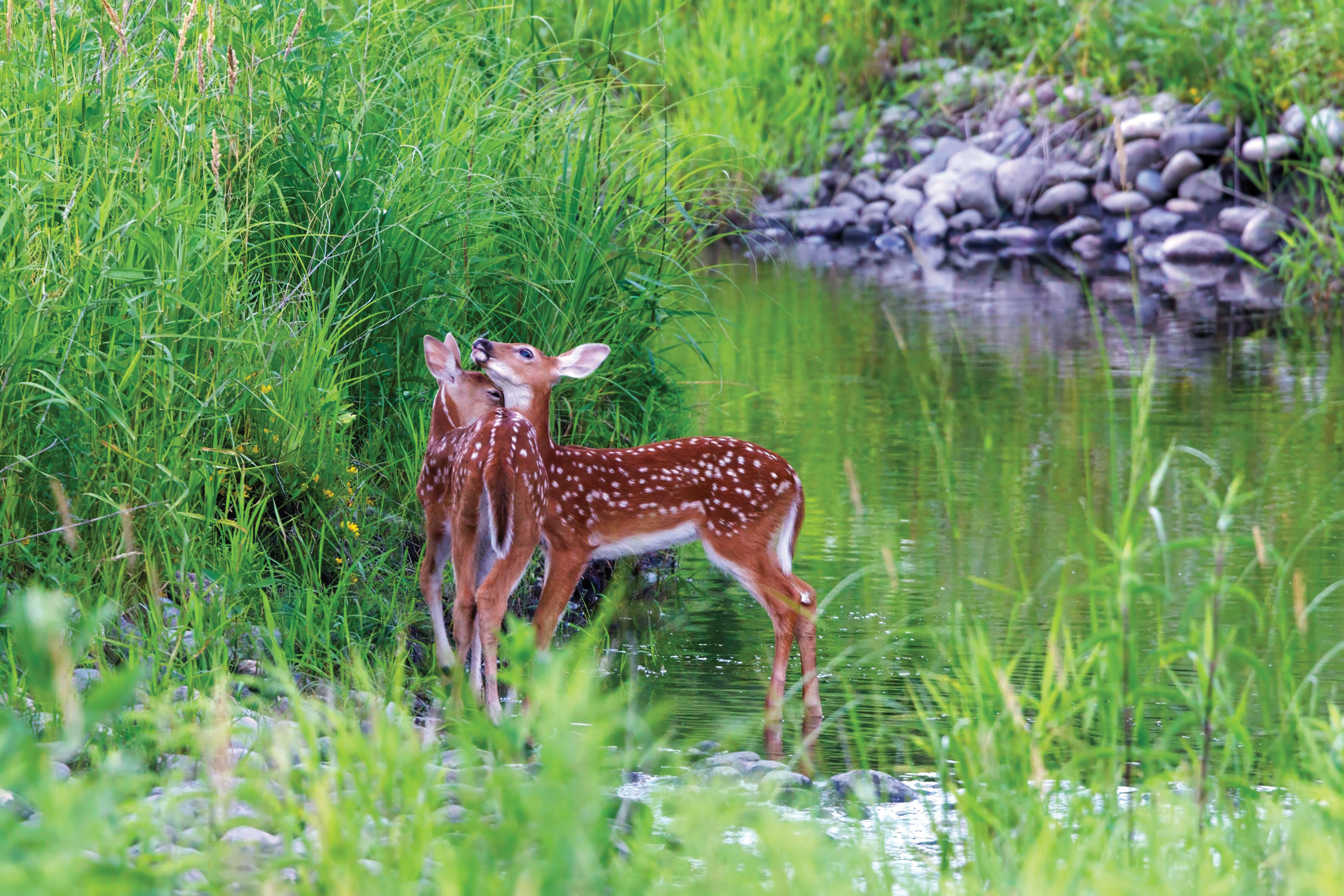
Photographer Dahai Zang snapped a fairytale scene at Buffalo Creek in Long Grove. These two white-tailed deer (Odocoileus virginianus) fawns sport hundreds of white spots on their rusty-brown coats. The markings help them blend into sun-dappled forests and meadows.
Imagine stepping into the woods, leaving behind the noise and stress of daily life. As you pause and breathe, a sense of calm takes over. There’s no rush or destination, only the soothing quiet of the woodland. Welcome to forest bathing, a practice that invites you to reconnect with yourself and nature.
Forest bathing, also called shinrin-yoku or forest therapy, involves immersing yourself in the outdoors—not through exercise or hiking, but by simply being present in the natural world. Its roots stretch back to a 1980s-era effort launched by Japan’s Ministry of Agriculture to help the country’s population reduce stress and improve health.
Forest bathing doesn’t require equipment. Just a picnic blanket will do.Continue reading →