Virtual camouflage hike

Leaves throughout the forest glowed gold against a backdrop of graying sky as I left Ryerson Conservation Area yesterday afternoon. This morning—as I entered the same preserve along the same road—the dark, skeletal branches were completely visible, stripped of their vibrant leaves that now lay in muddied piles on the forest floor.

These days of November mark a change from crisp colors to muted tones, which offer the perfect backdrop for animals to hide using camouflage. Lake County Forest Preserve educators often teach the concept of camouflage during environmental programs, where students hike in search of animal hides and mounts that have been hidden along the trail. Teachers and scout leaders, peruse our variety of school and scout programs to find a great fit for your group this year. Following is a virtual version of our camouflage hike. Continue reading
Heron highrise

This past weekend I had the pleasure of hearing Kenn Kaufman, a naturalist and bird expert, speak at the Smith Nature Symposium. He is somewhat of a “rock star” in the birding world. His novel, Kingbird Highway, chronicles a personal adventure hitchhiking around the country at the age of 16 on a quest to find birds—a story that has reached the status of folklore. Many years later, and surely a much longer “life list,” his keynote address at Ryerson Conservation Area focused on warbler migration: the phenomenon of these teeny tiny birds in every hue of the rainbow that travel thousands of miles across entire continents each spring and fall. He presented complicated doppler maps and in-depth scientific research on these migratory dynamos, but by the end of the discussion the focus had shifted to something more simple: the children from his young birders club.

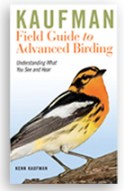
guide-bookLate that evening, as I settled down with one of his many guide books, Field Guide to Advanced Birding, I was struck by this same theme of simplicity. Kaufman urges folks to slow down and focus not on looking for the birds, but instead to spend time looking at the birds. He stresses getting to know the common birds of an area very well. By doing so, we are well on our way to knowing when a rare bird may enter the scene. This concept brought to mind one of the best places to take a long look at one common bird of Lake County, Illinois: a great blue heron rookery.

Continue reading

“Kwirr, churr, cha-cha-cha”

Walking through the woods in late fall, everything seems to be settling in—the colors calming to variations of brown, the dull roar of the wind the only sound. That is, until the staccato “cha-cha-cha” call of a red-bellied woodpecker breaks the lull of the wind, and a tiny black and white tuxedo (complete with a red cap) flashes past me, announcing the bird’s entrance into the woods.

Red-bellied woodpeckers (Melanerpes carolinus) are year-round residents of Lake County, Illinois. The sounds and sights of these birds in the woodlands and at backyard feeders command attention, especially against the bland backdrop of late autumn and early winter. Like its six fellow species of woodpeckers in Illinois, the red-bellied woodpecker excavates holes, commonly called cavities, in trees for nesting and shelter—all the while snacking away on the tiny critters crawling under the bark. Continue reading

A screech-owl’s story

Last week, many of us who work at the Lake County Forest Preserves had to say a sad goodbye. Our resident eastern screech-owl (Otus asio) passed away in the middle of the night. This male owl had spent the past seven years as an ambassador for the Lake County Forest Preserves, teaching thousands of people about the adaptations of raptors and owls. I have seen time and time again—from school children on education field trips to adults attending special events—a person’s eyes lock in and a look of amazement wash over them upon meeting this charismatic bird.

Sadly, his story is not uncommon. This particular bird was recovered in January 2004 as a juvenile. He was found by a concerned citizen in a driveway in Round Lake, Illinois with obvious head trauma and his left eye swollen and filled with blood. He was taken to Barnswallow, a raptor rehabilitation center in Wauconda, Illinois. It is suspected that this screech-owl was hit by a car, but he also had tiny sores on his talons and translucent, sheared tail feathers. These latter symptoms are signs of secondary viral infections caused by the West Nile Virus. After spending 16 months at the rehab facility, he was deemed unsuitable for release back into the wild due to the uncertainty of his eyesight in the injured eye. In the spring of 2005, he came to live in his very own mews (i.e. flight cage) near the farm area at Ryerson Woods. There he joined another resident bird, a red tailed-hawk (Buteo jamaicensis). Continue reading

Warbler fever

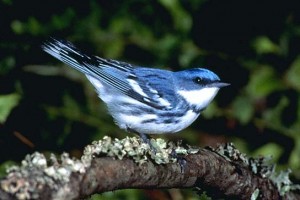
Birding fever hit a high this past weekend in natural areas throughout northern Illinois. Birders flocked in throngs with binoculars strung on their necks like potential Olympic medals and a hope of spotting some of the most coveted migratory birds— wood-warblers. Members of the family Parulidae, wood-warblers are the colorful jewels of migration from the sapphire blue of a cerulean warbler (Setophaga cerulea) to the amber orange of a Blackburnian warbler (Setophaga fusca). Yet, as these birds flit about in the treetops, no color is as visually striking as the lemony-yellow citrine that adorns so many warblers as they pass through our area on a flyway. Once these impish birds reach their destinations (as far as northern Canada for some species) and breed, they will molt their flamboyant plumage and become far less conspicuous, which is why seeing them in the spring is considered such a prize for birders.  Continue reading

“Whoo’s awake? Me, too!”

It was a cloudy morning just before dawn. As the sky lightened in the east, threatening storms became even more illuminated. I began to wonder if getting up this early for a bird count was going to be worthwhile. Still groggy with sleep, I crept out of the car and heard the distinctive “peenting” of American woodcocks (Scolopax minor) calling throughout Middlefork Savanna. The storms held off as a fellow naturalist and I headed down the trail, our eyes adjusting to the dim light of dawn. As we approached the craggy branches of an oak tree, we spotted the stocky body and characteristic “ear” tufts of a great horned owl (Bubo virginianus) hunched over its breakfast. If we heard or saw nothing else on this hike, I knew at that moment, getting up early was worth it. Continue reading

Glimpses from the car window, bootprints on the trail

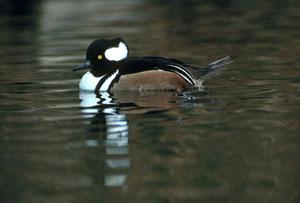
Like most of you reading this, my life is busy. Even though I work outdoors in the forest preserves, not all of my nature experiences occur there. Many days I have to take the glimpses of nature where I can get them. On my drive home from work last week, glancing at the “not-so-glamorous” retention pond next to the tollway, I spotted my first hooded merganser of the year. I knew the gang was back, although some of them not for long. This “gang” I’m referring to is the group of migratory waterfowl that show up here in the early spring during migration en route to their final destinations further north. With names like horned grebe, American wigeon, northern shoveler, and gadwall (just a few of the species seen in the past few days at Independence Grove Forest Preserve, here is the complete list), who wouldn’t want to meet this cast of characters?

This time of year is the perfect opportunity to take a peek at some fascinating birds close to home. Continue reading